

Transport Digital Twins
The hard part is not building the twin. It is knowing when to stop trusting it.
- Digital Twin Evropská
- Drift diagnosis
- Human-in-the-loop control
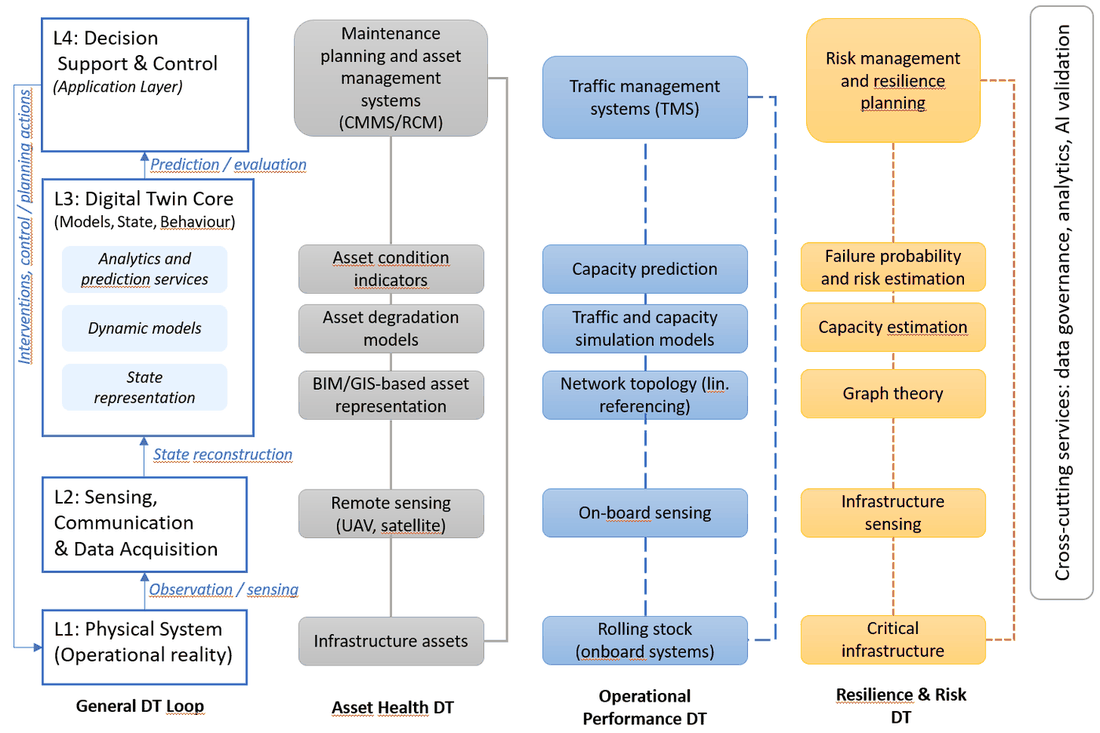
- Railway reference architecture
- VEXA autonomous train
Every operational twin drifts
The state of the art hides drift by quietly re-fitting demand until simulated flows match the counts. That produces a model which agrees with yesterday and cannot be trusted about tomorrow — and, worse, gives no signal that anything is wrong. We treat the residual as an information channel instead.
Two independent forecasts run in parallel: one extrapolated from detector measurements, one propagated by the simulator from its adapted state. Their divergence is a measurable indicator of model consistency. When they disagree, something in the world changed — and the next question, which almost no operational twin can answer, is what: a supply-side disruption, or a shift in how people are travelling.
The same discipline produced our definition of a twin. Bidirectional coupling has to be measurable rather than asserted, so we specify it as control latency, intervention frequency, degree of automation and operational impact. On that yardstick most celebrated city-scale systems are digital shadows. We think saying so is a scientific obligation, because overstated digitalisation claims cost municipalities money and credibility.
Scientific contribution
- Two independent forecasts, one diagnostic signal. Measurement-driven extrapolation and simulator propagation run in parallel; their divergence becomes a measurable model-consistency indicator rather than a nuisance to be smoothed away.
- Self-calibration that stays physically plausible. Path-flow estimation enforcing Kirchhoff conservation at junctions and screenlines — so a corrected state is still a state the network could actually be in.
- A measurable definition of “bidirectional”. Control latency ≤ 5 min, intervention frequency 5–15 min, degree of automation, operational impact — with human validation closing the loop, because a safety-critical system should not close it alone.
- A four-layer railway architecture specifying the boundary between a Digital Register and an operational twin, so local twins can compose into a federated one.
Operational evidence
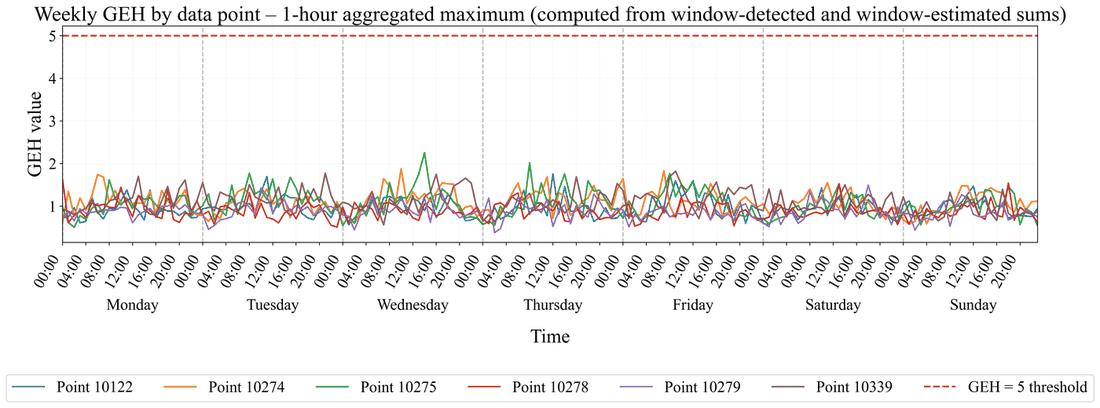
Digital Twin Evropská: a three-kilometre multimodal Prague corridor with about twenty signalised intersections, running in real time on a single server. Daily mean GEH between 0.29 and 0.43 — an order of magnitude inside the accepted threshold.
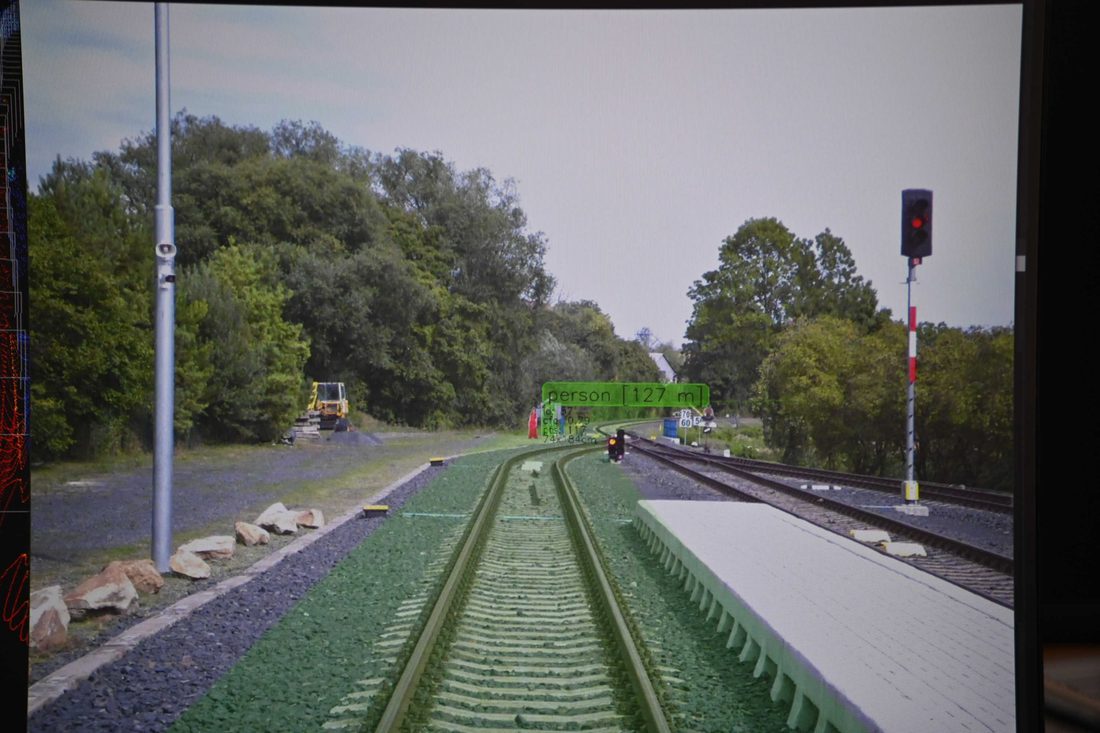
The project delivered a methodology endorsed by the Czech Ministry of Transport and was closed by the funder as “succeeded as specified”. On the railway side, the VEXA autonomous-train expert system was built with AŽD Praha.
Three digital twin manuscripts are in preparation. The proof of this pillar today is the running system and the certified methodology, not the paper count.
- Methods used here
- M5 SUMO · TraCI · meso/micro coupling
- M3 Non-linear Kalman filtering · data fusion · ETL
- M1 State-space estimation
- M4 Graph theory for network risk
- All six groups →
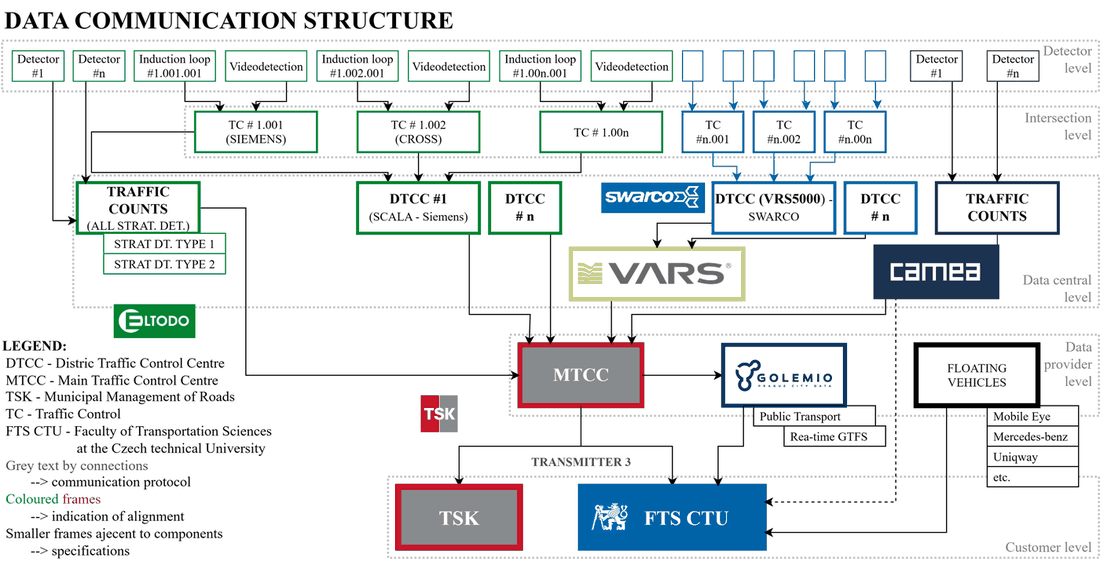
What a calibrated twin looks like
Where we stand on Europe’s Rail, plainly
CTU is not currently a participant in an Europe’s Rail flagship project. This competence rests on the reference architecture above, on VEXA with AŽD Praha, on the RESISTRANS railway work packages starting in 2026, and on railML.org and EURNEX membership. Europe’s Rail is a target for collaboration — this is an offer, not a claim.
Projects behind this pillar
| Project | Funder and identifier | Period | Our role | Pillar |
|---|
Publications
Every entry links to its DOI. Open-access items are marked and can be read without a subscription.
Who we want to hear from
| We are looking for | What we would contribute | Target instruments |
|---|---|---|
| Cities building or procuring a digital twin | Methodology transfer, independent verification, a calibration and validation protocol, vendor-independence review | Horizon Europe Cluster 5 · Digital Europe · EIT Urban Mobility |
| Europe’s Rail consortia and System Pillar activities | Reference architecture, closed-loop formalisation, interoperability with urban twins | Europe’s Rail JU · System Pillar contracts |
| Infrastructure managers with a Digital Register programme | The register-to-twin boundary, and traceability from design-time data to runtime condition estimates | Europe’s Rail · bilateral cooperation |
| Groups working on human–automation interaction | Operator studies in a real control-centre setting — response time, acceptance rate, agreement with recommendations. Our declared future work, and we want a partner on it | Horizon Europe · bilateral doctoral cooperation |