

Cooperative Traffic Management and CCAM
Uncoordinated automation makes intersections worse, not better.
- MAVEN (H2020)
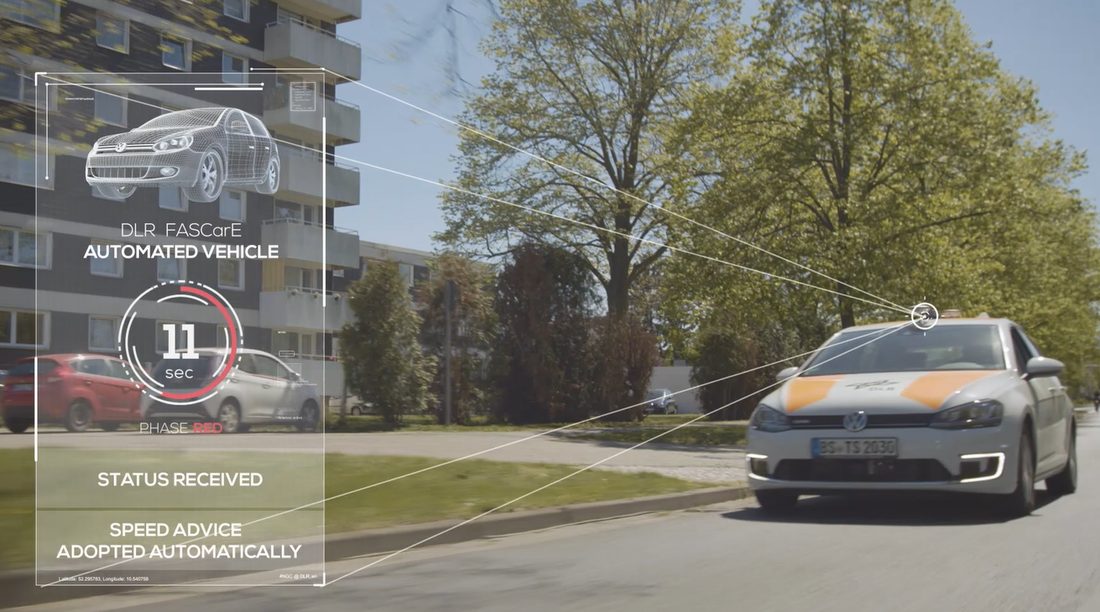
- GLOSA and V2X message sets
- Multi-agent signal control
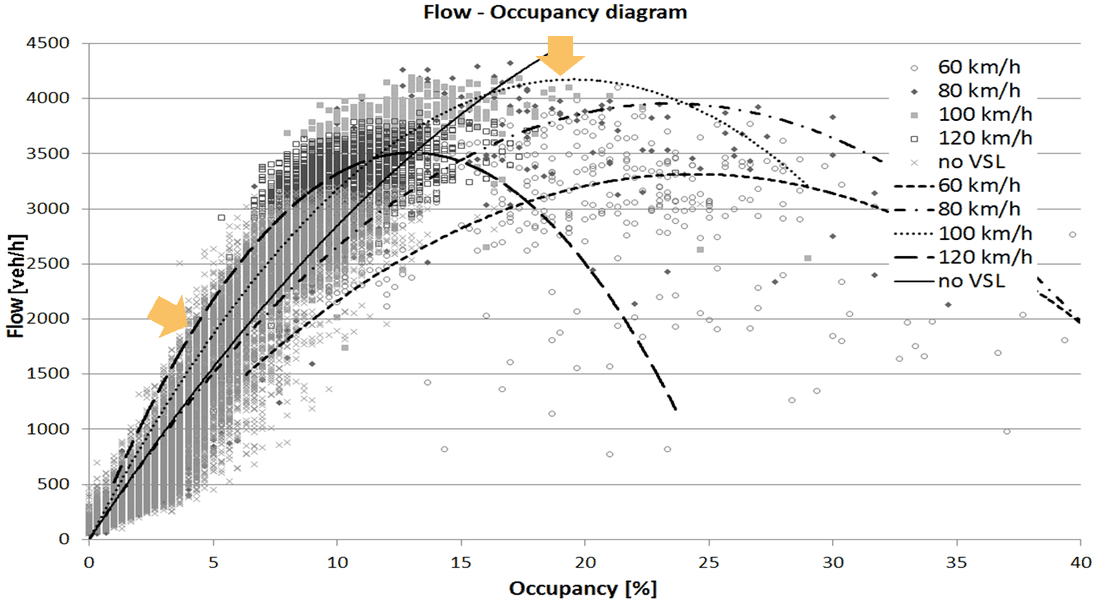
- Variable speed limits
- Mobility on Demand
- Impact assessment
What must a control centre become when it no longer commands the network?
Left to optimise locally, automated vehicles produce phantom jams, unstable queue formation and lower intersection throughput. The question is not whether automation arrives — it is what a traffic management centre has to become in order to stay in control of a network it no longer fully commands.
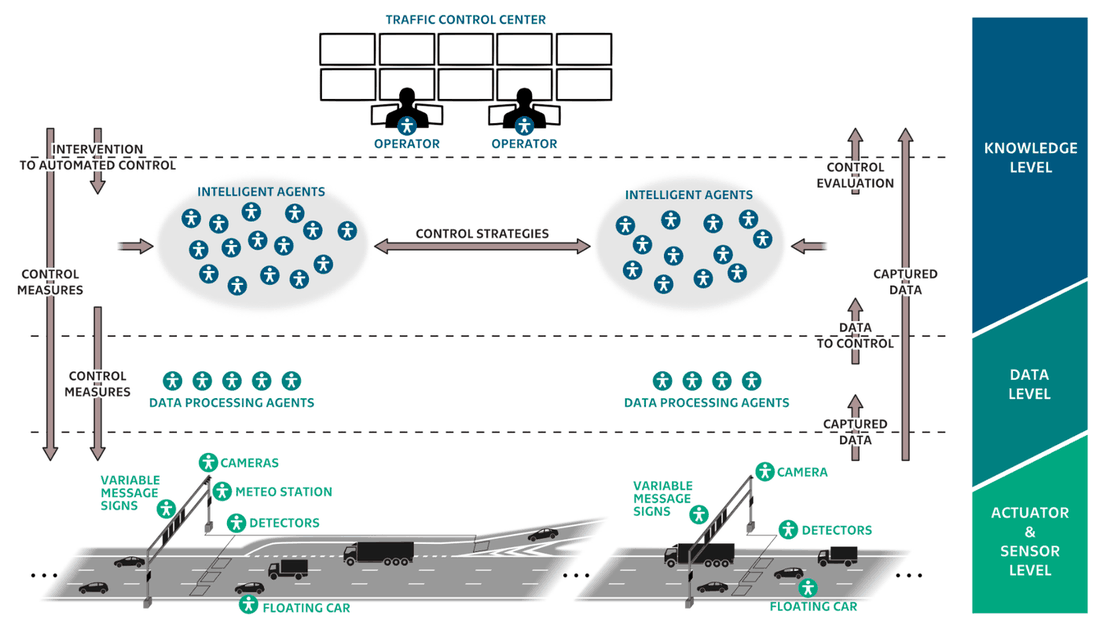
We treat this as one field rather than two. Connectivity and cooperation are not a separate topic from traffic control: they are the basis on which distributed, multi-agent control becomes possible at all. The arc runs from a control system operating today on a European capital's ring road, through three generations of soft-computing controllers, to negotiation-based cooperative control validated in European field trials — and the deployed system at the start of that arc is what makes the rest credible.
Scientific contribution
- Hierarchical self-organising control. Multi-level top-down guidance of self-organised dynamic platoons outperforms both fully centralised and fully decentralised control — the architectural conclusion of the MAVEN programme.
- Negotiation as a control primitive. Mutually beneficial information exchange between a signal controller and an approaching platoon, formalised, simulated and then reduced to a signal-plan stabilisation cost function.
- Impact attribution under partial penetration. Queue-state estimation and effect attribution when only a fraction of the fleet is connected — the regime every city will actually operate in for the next two decades.
Operational evidence
From H2020 MAVEN, where CTU led the impact assessment work package; figures quoted from the project's CORDIS report. Queue-length estimation improved by 50 % at low connected-vehicle penetration.
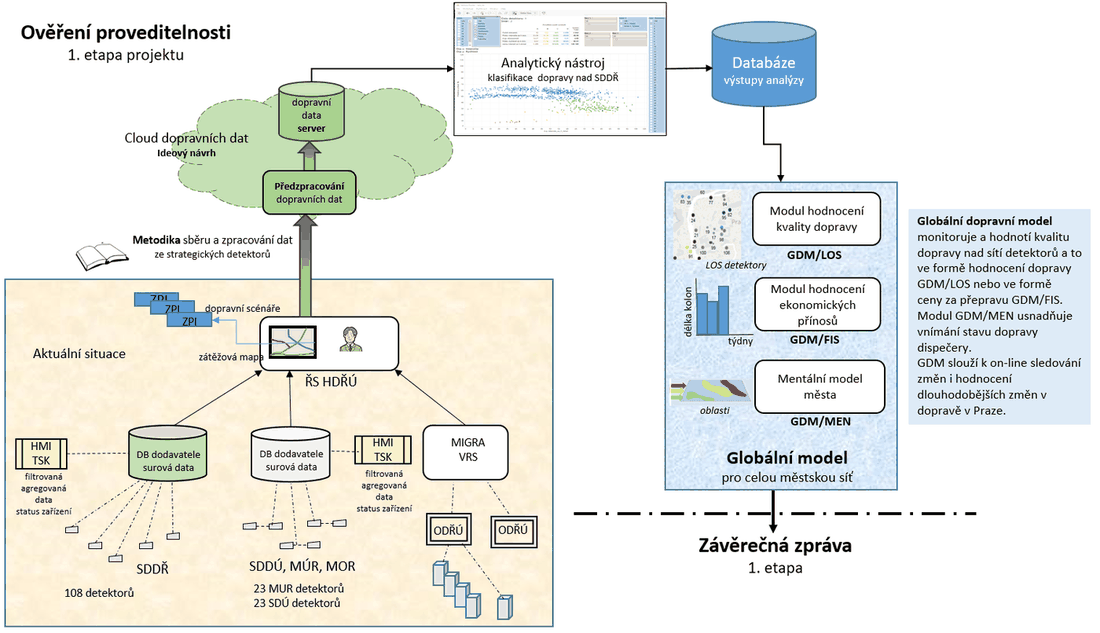
Also: a motorway line traffic control system running today on the Prague City Ring Road; patent NL 2018711 on signal-plan stabilisation; and four V2X message extensions proposed to ETSI ITS and the Car2Car Communication Consortium.
- Methods used here
- M5 SUMO · Vissim · Aimsun
- M2 Multi-agent systems · fuzzy inference
- M1 State-space models · MPC
- M6 Impact assessment by microsimulation
- All six groups →
Twenty years in one arc
A declared direction with no results yet
Human–machine interaction and trust in automated transport: handover in semi-automated systems, in-vehicle AR transparency, external signalling towards pedestrians and cyclists, and long-term trust formation. We have the driving simulator and eye-tracking infrastructure and no findings to report — which is precisely why we are looking for a partner on it.
Projects behind this pillar
| Project | Funder and identifier | Period | Our role | Pillar |
|---|
Publications
Every entry links to its DOI. Open-access items are marked and can be read without a subscription.
Who we want to hear from
| We are looking for | What we would contribute | Target instruments |
|---|---|---|
| Cities and control centres preparing for mixed automated traffic | Impact assessment, algorithm design, before-and-after evaluation methodology, simulation of local conditions | Horizon Europe Cluster 5 · CCAM Partnership |
| CCAM pilot and demonstration consortia | Evaluation work package leadership; modelling of pilot sites; queue and emissions estimation at low penetration | CCAM Partnership · national testbeds |
| Roadside ITS and traffic controller suppliers | Negotiation-based control, signal-plan stabilisation, cooperative queue estimation | Bilateral R&D · TA ČR TREND · Eurostars |
| Human factors groups working on trust in automation | A driving simulator with eye tracking and a declared agenda on handover, in-vehicle AR and external signalling | Horizon Europe Cluster 5 · CCAM Partnership |