

Demand Modelling and Synthetic Populations
An aggregated model reproduces flows but cannot say why — which is exactly why it cannot be trusted about a policy nobody has tried.
- Synthetic populations
- Activity-based modelling
- MATSim at metropolitan scale
- OD estimation from open data
- GDPR by construction
Travel demand is derived from what people need to do, not from zones
MaaS, shared fleets, charging siting, hybrid working, response to disruption — all individual-level phenomena. A trip-based model can always be fitted to observed link flows; that is precisely the reason it cannot be trusted to extrapolate. We work from the axiom that demand is derived entirely from the human need to perform activities at spatially separated locations.
That commits us to activity-based modelling, and activity-based modelling commits us to synthetic populations: socio-demographically accurate individual agents reconstructed from aggregated census and survey data under strict data-protection constraints.
The boundary with Pillar 3 is deliberate, and it is what keeps the two free of overlap. Pillar 3 asks why an individual chooses; Pillar 4 builds the population and simulates the consequences. Pillar 3 produces the utility specifications and behavioural parameters; Pillar 4 consumes them. Different projects, different publications, different partners — statistical offices and planning agencies rather than behavioural scientists.
Scientific contribution
- Synthesis error under disclosure constraints. Socio-demographically accurate individuals reconstructed via iterative proportional fitting and Bayesian networks, GDPR-compliant by construction rather than by disclaimer — and with the fidelity-versus-disclosure trade-off stated rather than assumed away.
- An inference layer that operational twins lack. A dual-loop architecture in which a slow behavioural loop and a fast operational loop meet at a diagnosis step: was that discrepancy a supply disruption or a demand shift? Answered with stated confidence, instead of force-fitting demand to counts and calling the result calibration.
- Activity scheduling as the transmission mechanism. Structural changes in working patterns reshape peak demand through scheduling, not through trip generation — which is why trip-based models systematically misrepresent hybrid work.
Operational evidence
The reference implementation is fully open access, so a partner can read and audit the pipeline before contacting us. The policy paper that followed takes the whole chain through the evaluation of real interventions — the step most synthetic-population papers never reach.
Joint origin–destination estimation for cars, cyclists and pedestrians from counts, turning movements, travel times and OpenStreetMap land use — which is what a city without a household travel survey actually needs.
- Methods used here
- M3 Data fusion · population synthesis
- M5 MATSim · agent-based simulation
- M1 Utility specification
- M6 Scenario evaluation
- All six groups →
A population, not a matrix
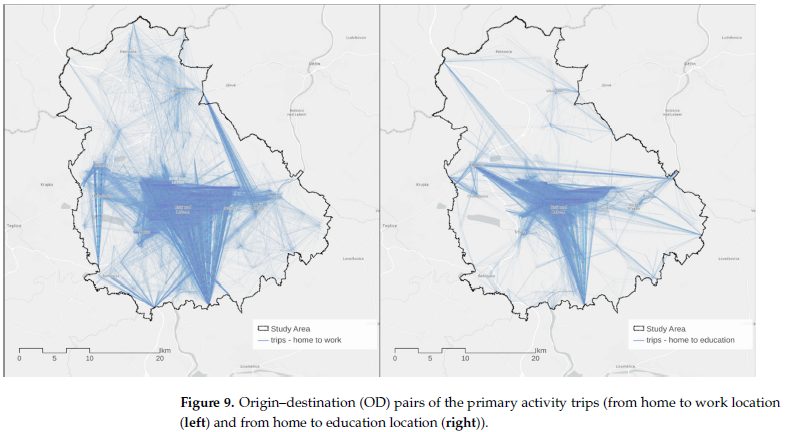
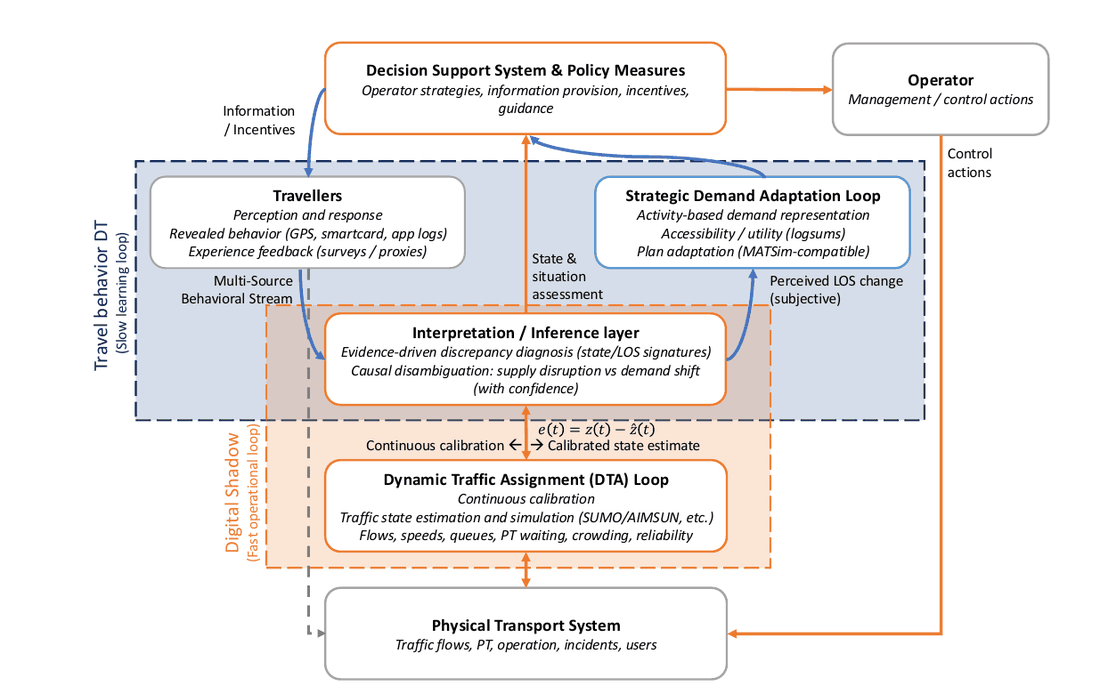
The pipeline, end to end
Census and micro-survey data → population synthesis → activity-chain generation, a full 24-hour schedule per agent → MATSim co-optimisation of route, mode and timing by iterative replanning → scenario analysis. Reproducible and version-controlled from source data, and benchmarked against UrbanSim, TRANUS, METROSIM and ILUTE.
Projects behind this pillar
| Project | Funder and identifier | Period | Our role | Pillar |
|---|
Publications
Every entry links to its DOI. Open-access items are marked and can be read without a subscription.
Who we want to hear from
| We are looking for | What we would contribute | Target instruments |
|---|---|---|
| Urban planning agencies and metropolitan authorities | Synthetic population construction for their region; activity-based policy testing for MaaS, road pricing, low-emission zones and hybrid-work futures | EIT Urban Mobility · Interreg · national planning contracts |
| The MATSim and activity-based modelling community | Coupling to operational digital twins through the inference layer, and comparative validation on two regional models | Horizon Europe · MATSim community |
| Statistical offices and data-protection researchers | Synthesis error minimisation under disclosure constraints | Digital Europe · national statistics cooperation |
| Crisis management and civil protection authorities | A national-scale synthetic population for evacuation and crisis demand analysis | Horizon Europe Cluster 3 · national security research |