

Public Transport Quality and Service Design
Every optimisation assumes the operating paradigm was already chosen. Somebody decided by convention — and then everyone optimised inside that decision.
- Service Friction
- Asymmetric Nash bargaining
- Passenger-weighted route deviation
- APC and GTFS data chain
- Demand-responsive transport
The unexamined step at the very beginning of transport planning
Route design, timetabling, fleet assignment and dispatch are all well-developed optimisation problems. Every one of them starts after somebody decided whether a corridor is a fixed route, a hybrid, or fully flexible on-demand service. That decision is usually made by convention, by politics, or by whatever the last consultant recommended.
With demand-responsive transport and autonomous shuttles genuinely available, the gap has become expensive. We are closing it from two directions: top-down with a theory that derives the operating paradigm from corridor characteristics, and bottom-up with passenger-weighted indicators that make the accessibility-versus-directness trade-off in existing routes measurable and auditable.
Scientific contribution
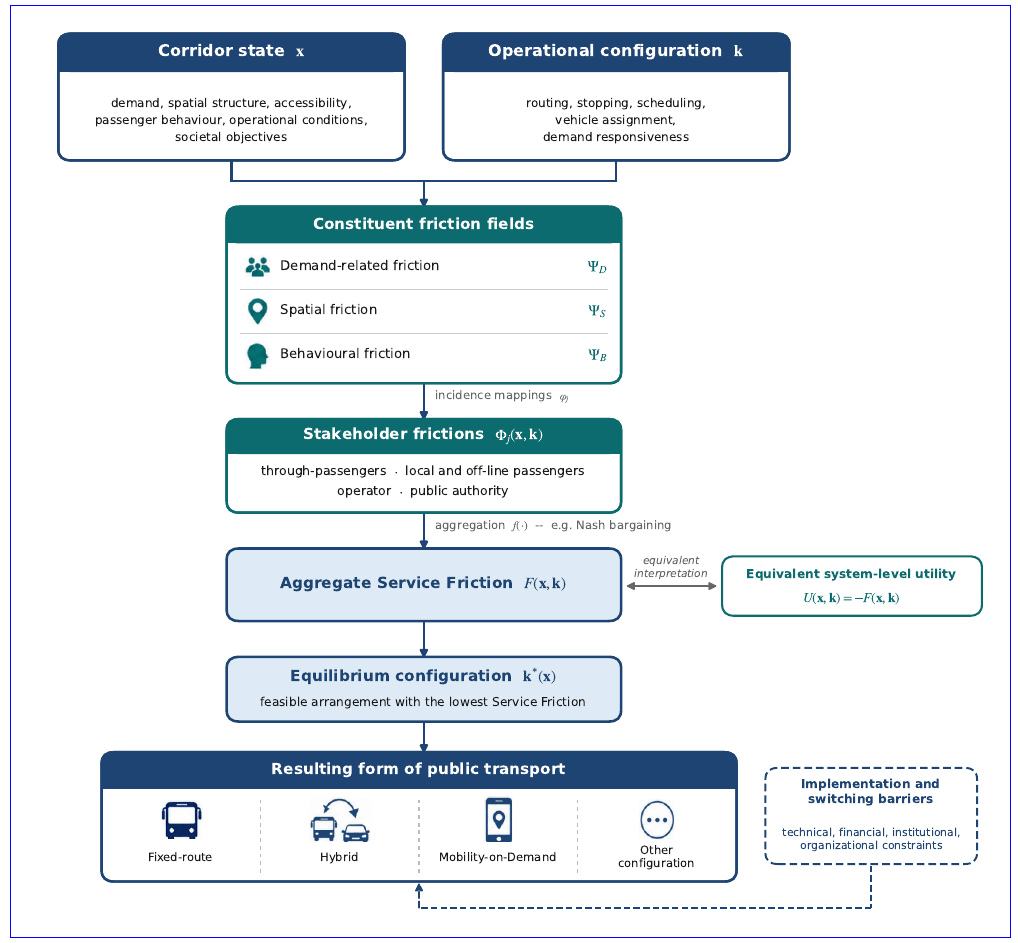
- Service Friction. A latent scalar construct measuring the mismatch between a corridor's intrinsic state and the operational configuration applied to it. Fixed-route, hybrid and on-demand become regions of one configuration space rather than separate concepts, and the preferred configuration is derived as the equilibrium that minimises friction.
- Non-compensable aggregation. Configuration choice as asymmetric Nash bargaining among corridor stakeholders, aggregated by weighted geometric mean — so a gain to the operator cannot offset a loss to through passengers. A direct answer to the equity objection to additive cost–benefit analysis.
- Stability regions and hysteresis. A corridor can sit outside the stability region of its current configuration and still not move, because switching costs and institutional barriers are real and can be quantified.
- Operational versus structural time loss. A formal separation between delay a bus lane can fix and delay built into the route alignment itself.
Operational evidence
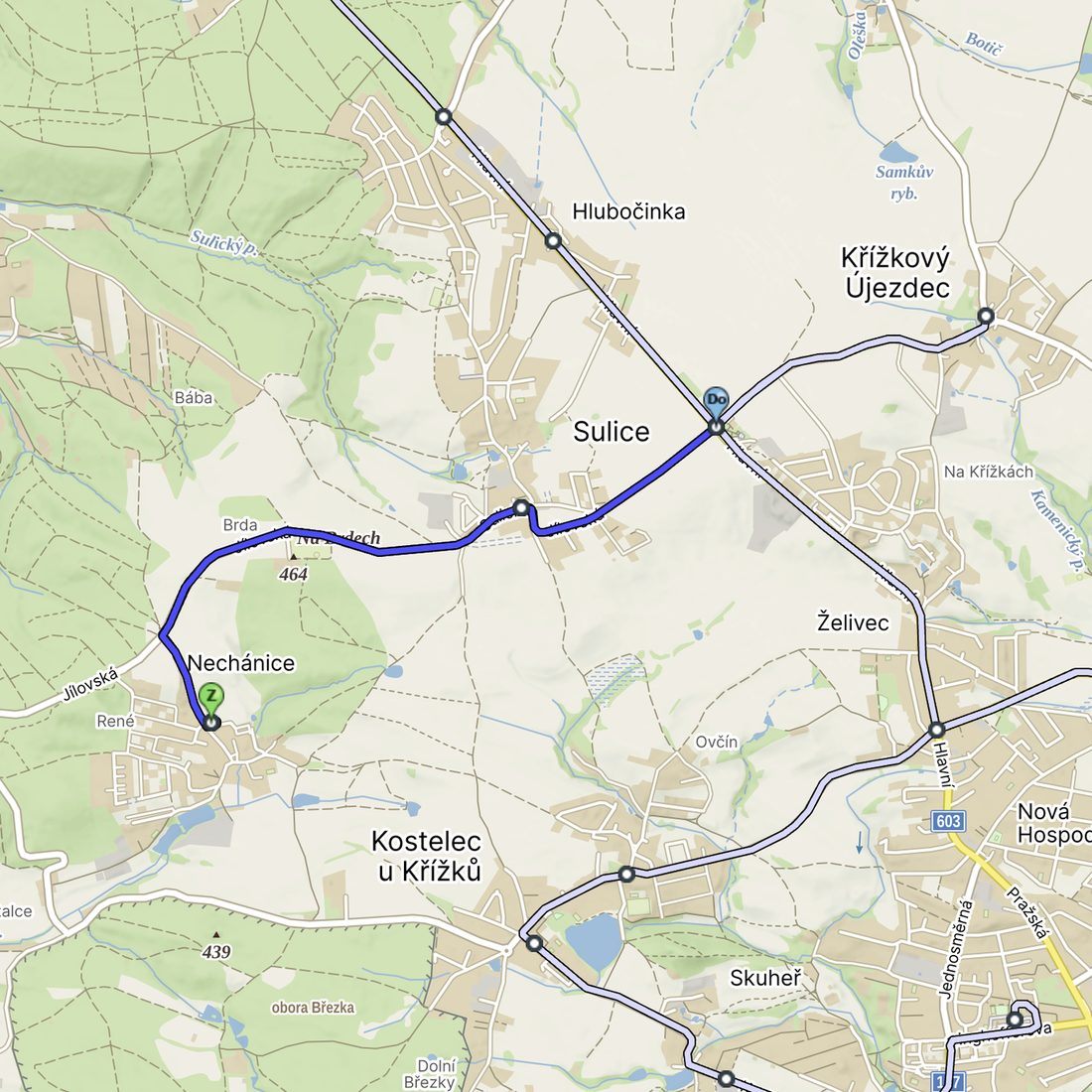
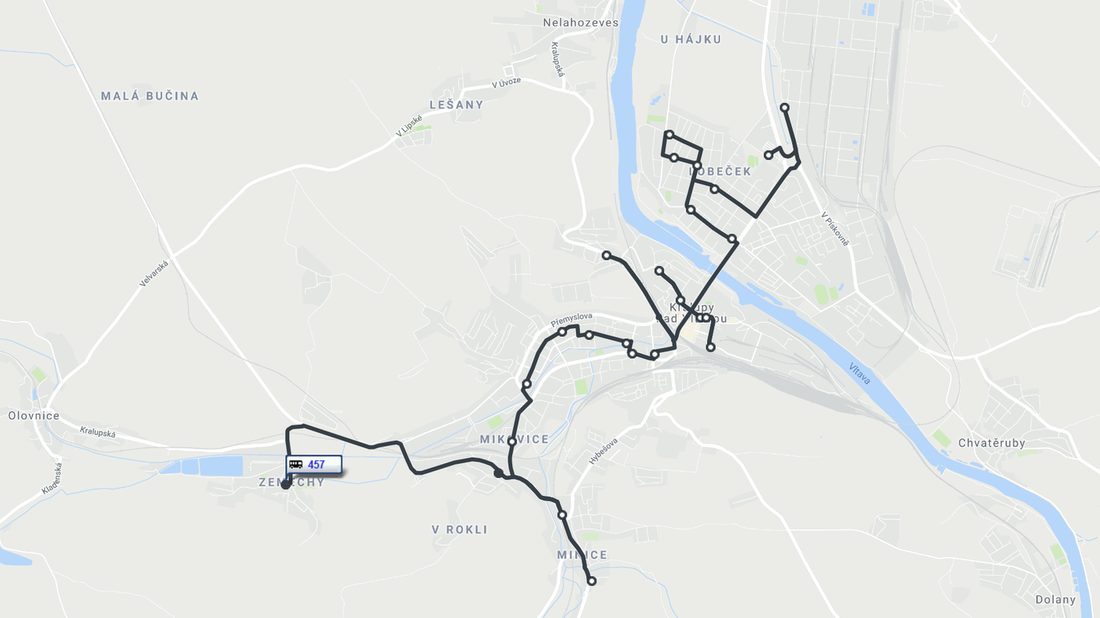
The question we can now answer with data: who pays for a detour? A deviation improves access for the passengers it serves and imposes in-vehicle time on everyone travelling through. We compute that balance from automatic passenger counting and GTFS records at inter-stop-section resolution.
Routes 335, 337 and 339 in the Prague Integrated Transport system, chosen because they combine suburban congestion, branching structures, deviations serving low-density areas and heterogeneous passenger exchange. Shortest-path references from OSRM; passenger loads normalised for partial APC fleet coverage.
Conflating operational with structural time loss is why priority measures sometimes get deployed on corridors where they cannot possibly help.
- Methods used here
- M4 Game theory · asymmetric Nash bargaining
- M1 Econometrics
- M3 APC · GTFS · OSRM processing chain
- All six groups →
From corridor state to service form
Projects and publications
This pillar is the newest of the five, and its theoretical core is still being written up. What is already published is the indicator work; the Theory of Service Friction and the composite quality index are in preparation. The funded platform carrying it is RESISTRANS, where service design is one of the ten work packages.
| Project | Funder and identifier | Period | Our role | Pillar |
|---|
On naming
The indicator is formally the passenger-weighted route deviation ratio, and the composite is the integrated public transport operation quality index. Nobody remembers either acronym, so in conversation we use the question they answer: who pays for a detour, and is this service any good from the passenger's seat.
Who we want to hear from
| We are looking for | What we would contribute | Target instruments |
|---|---|---|
| Public transport authorities and integrators | Route-level quality diagnosis, identification of structurally inefficient deviations, and a defensible evidence base for network redesign | Regional and national PTA contracts · Interreg |
| Demand-responsive transport and autonomous shuttle programmes | Paradigm selection methodology, corridor state characterisation, transition boundary and hysteresis assessment | Horizon Europe Cluster 5 · CCAM Partnership · EIT Urban Mobility |
| Researchers in transit network design and optimisation | The decision layer above their optimisation problems, and empirical operationalisation of friction fields | Horizon Europe · bilateral academic cooperation |
| Rural and low-density mobility programmes | Evaluation of deviations serving low-demand areas, and equity-preserving aggregation | Europe’s Rail capillary line activities · Interreg |